
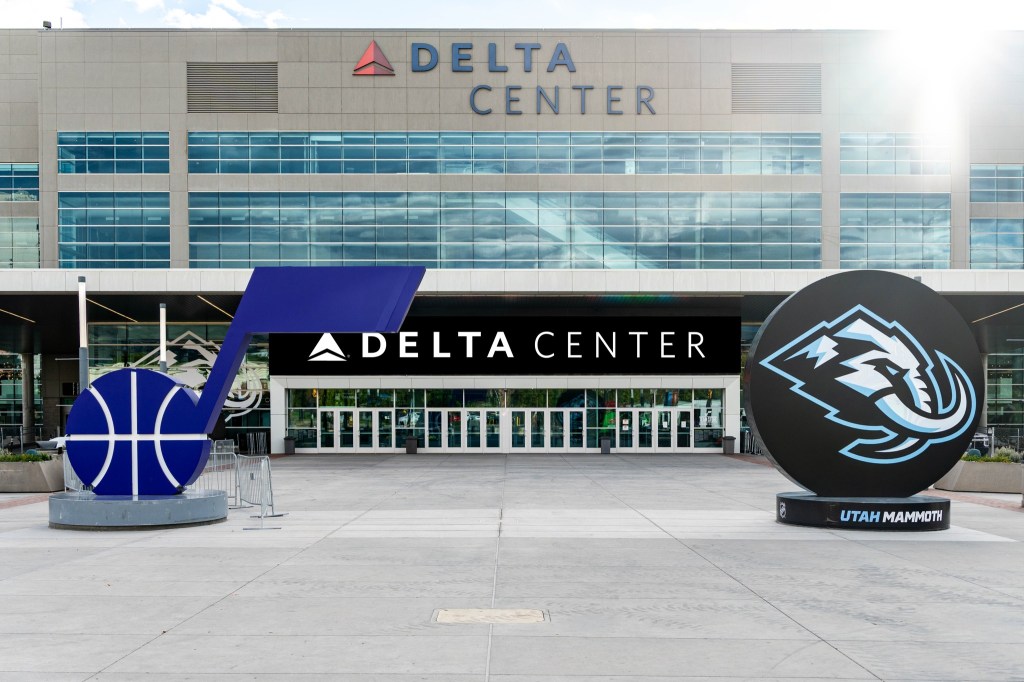
Part two in discussing the Utah Mammoth power play problems
The power play is one of the most important aspects of hockey, and today I have the second part of the two-part breakdown of everything power play. The other day, I wrote part one discussing what power plays were, and general high overview of power play systems. Today, I’ll be getting into the details of the Mammoth power play, coaching, personnel usage, and overall thoughts.
Mammoth Power Play Personnel
Mammoth Power Play System
Player Stats
What’s Not Working?
What Can They Do?
Mammoth Power Play Personnel
Let’s start at the top:
Mammoth Coaching:
Head Coach:
Andre Tourigny, head coach of the Utah Mammoth is ultimately responsible for all player decisions. However, Tourigny – like most NHL coaches – utilizes specific bench coaches to run special teams. As a result, while Tourigny is ultimately responsible for the team’s play, the power play instead goes through…
Power Play Specialist:
Blaine Forsythe is the Mammoth’s power play coach. He is directly responsible for the systems that are run, as well as which personnel play in which position and why.
Forsythe comes to Utah from the Washington Capitals. Brought over before the Mammoth existed, Forsythe had spent a couple of seasons with the team. In 2023, with the Arizona Coyotes, Forsythe helped the team generate a 22% successful power play, good for 15th in the league. Last year, this improved with the Utah Hockey Club. The team jumped to top 10 in the league, with more than 24% success with the extra man.
In 2025, however, Utah is just barely above last place in the league, running 15.6% and just above Colorado at 31st place.
Utah’s power play lines:
Currently, the Mammoth power play lines have lined up as:
Power Play 1st Unit:
Forwards: Nick Schmaltz – Barrett Hayton – Dylan Guenther – Clayton Keller
Defenseman: Mikhail Sergachev
Power Play 2nd Unit:
Forwards: Lawson Crouse – Jack McBain – JJ Peterka – Michael Carcone
Defenseman: Sean Durzi
Logan Cooley – who plays on the PP1 unit, has been out injured for the past 28 games. As a result, Utah has been running this current system for the past nearly 30 games. Once Cooley returns, however, the Mammoth lines will be adjusted again.
Mammoth Power Play System
The Why:
The Mammoth run a 1-3-1 system. This system is one that Forsythe built with the Washington Capitals, and this system was extremely effective for Washington for years. In 2011, Washington was 18th in the league, with a 17% PP rate. Starting in 2012, Washington was top 10 in the league in power plays, up through their Cup run.
Forsythe relies on the 1-3-1 system because he’s seen unreasonable levels of success with it. Before this system was implemented (from 2005 – 2011), Washington scored 455 power play goals, a 19% rate. The Capitals top goal scorer, some Russian kid named Alex Ovechkin, had 111 of those 455 goals, averaging 2.31 goals every 60 minutes of power play time played.
From 2012 – 2022, however, this changed significantly. Washington scored the third most power play goals in the NHL over those 10 years, with 568 goals in total. The Capitals 22.4% was second only to Edmonton’s 22.5% over that same 10 year’s time.
Ovechkin scored 188 goals, 55 higher than the next best player, and added nearly a goal per 60 minutes with the man up (3.22 ppg/60).
The How:
To try and give an image of assignments, I’ve copied over the image from the 1-3-1 from the other article. The name of the player and the blue circled number corresponds to the player position where the Mammoth players generally fit in the following spots:
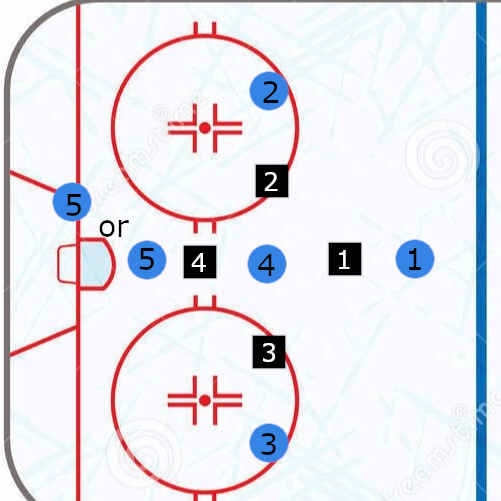
First Unit:
Mikhail Sergachev (1)
Clayton Keller (2)
Dylan Guenther (3)
Nick Schmaltz (4)
Barrett Hayton (5)
Second Unit:
Sean Durzi (1)
Michael Carcone (2)
Lawson Crouse (3)
Jack McBain (4)
JJ Peterka (5)
Now, that 2nd line is less static in positions, as Peterka plays in the low boards sometimes, and Crouse sometimes takes the 4 position, but overall this is the layout that the Mammoth use.
Mammoth Player Stats and Notes:
The Top Line:
Since the top line runs the majority of power play time, I’ll focus on the 5 man unit here. While I have some concerns with the PP2 unit, they play – on average – just 30% of the time.
Clayton Keller – averages the most ice time on the power play of all of the Utah Mammoth. He runs on average 3:21 of power play time a game, and plays nearly 70% of all power play time. Gold medalist and team co-leader with 15 power play points, Clayton Keller has 1 goal and 14 assists through 55 games. Keller is on pace for just 23 power play points, and 2 goals, for the year.
Last year, Keller led Utah with 37 points – 10 goals, 27 assists in 81 played games.
Notes: Keller’s stats are suffering big time on the power play due to a highly ineffective shot. Keller’s shot volume is about the same as last year, however he has scored on just 3.4% of all his chances. This is down from 21% last year.
Keller was good for 2.1 goals per 60 minutes on the power play last year. This year, he’s averaging 0.3. That’s an 86% reduction in goal scoring rate, and a massive reason the team is struggling.
Dylan Guenther – has the next highest play time on the power play, with 3:17 of power play time a game, 68.4% of all times. Guenther has a total of 13 power play points, tied for most goals on the power play with 5. He is on pace for 8 goals, and 20 total points.
Last year, Guenther was second best on the team with 29 power play points – 12 goals and 17 assists.
Notes: While Guenther’s production is down, his effectiveness is still there. However, his shooting percentage is down – from 19% last year, to just 11% this year.
Nick Schmaltz – plays nearly identical time to Mikhail Sergachev (next up), and has been good for 12 points so far this year. His 5 goals actually pace him to nearly where he was last year on the power play. However, his assists are down and he’s pacing to close to 12 assists, for an expected 8 goals, 20 points – almost exactly like Guenther.
Nick Schmaltz had 9 goals, 16 assists in 2024-2025.
Notes: Schmaltz is shooting more than last year, and as a result his total shooting percentage is down. His goal production is close to where it needs to be. However, the assist drop is a direct result of the difficulties his linemates are having with finishing.
Mikhail Sergachev – plays the point, the only defenseman in the line. As such, his role is more to dictate play and provide assists more than goals. His stats reflect this with 4 goals, 11 assists for 15 points. He’s the only Mammoth player that has seen an increase in their power play effectiveness over last year. He scored just 3 goals in 2024-25.
Sergachev had 20 assists last year, closing the year out with 23 points in total. His totals are pacing close to last year’s stats.
Notes: Sergachev’s ability to quarterback a power play hasn’t changed; his effectiveness is actually on the verge of increasing in a year where everyone else has regressed significantly.
Barrett Hayton – plays the 5th and final spot on the power play, though this is likely to change with Cooley’s return. Hayton has been the least effective player on the unit, with just 3 goals and 2 assists on the power play.
Last year, Hayton had 15 total points, with 7 goals and 8 assists.
Notes: Hayton’s performance is exceptionally bad. In the #5 spot, closest to the goal, the main plays should be to tip shots and collect rebounds. This is prime opportunities for “gritty” goals and primary assists. Hayton’s fallen flat here and is a major piece of the machine that’s malfunctioning.
What’s Not Working?
Well, simply put, they’re not scoring. But It’s easy to say that – there’s a lot more under the hood. It boils down to three factors – zone time, shot quality and shooting percentages. Utah struggles at all three this year.
Access denied:
An offensive zone face-off occurs after a penalty, and winning this draw is extremely important for a power play unit. So far this year, Nick Schmaltz is about 50% on face-off wins. This is on par with where he was last year for power play draws. He takes the majority of the faceoffs in 2025-26. So far, he has lost 51 of 101 draws.
This means that 51 times the power play unit has not controlled the puck to start, shaving 10+ seconds off the clock as the team retrieves the puck and has to re-enter the zone.
Utah has struggled with power play zone entries as well, which further kills time as the puck may be sent down the ice again. Even when Utah enters, however, it takes time to set up a system, adding another few seconds to the time needed to execute.
Misses are just as bad as clears:
While Keller’s shooting percentage has cratered, it’s notable that attempted shots that miss the net (high or wide) do not count in actual shot totals. Neither do blocked shots. This means that even though Keller’s scored 1 goal on 29 shots, his total shot attempts are far, far higher. However, none of the records I have access to share the total shot attempts on the power play.
So, some of this is conjecture from re-watching the past 10 games worth of power plays. If anyone has access to more rich data, email me at saltystampede@gmail.com so I can revise models with more accurate data please!
When Guenther, Keller, and Hayton shoot and miss the net, the 1-3-1 system is very unforgiving in keeping pucks in at the blue line. When a Guenther shot from the point misses high or wide, if Keller can’t immediately control the rebound along the boards, the puck will likely clear the zone. This leads to lower power play time, as the team needs to exit the zone and regroup.
Utah, as a team, is pacing for nearly 10% more shots on goal this year versus last year on the power play. This is a double edged sword, however. Increased shots also mean increased misses – and those misses keep turning into zone clearances for the other team, killing time and further straining the power play.
All shots aren’t created equal:
There was a great article on the Athletic pointing out how the shooter from the dot in a 1-3-1 system is less effective than he used to be. This is due to a number of factors, but mostly the fact that the seam passes are difficult to hit, and goalies have been better at lateral motion knowing the shot will occur.
Mainstays at the system, like Alex Ovechkin, have been seeing lower goal totals, and unless you’re a pinpoint accurate shot like Ovechkin, or Leon Draisaitl, the ability to hit ever shrinking positions from a reactionary goaltender gets harder each year.
Additionally, shots that are not screened or redirected keep getting easier for goaltenders to track and make athletic saves on.
A shot from Sergachev at the blue line is less dangerous than a shot from Guenther at the dot, is less dangerous than a shot from Schmaltz in the slot, or Hayton by the side of the net. This year, Sergachev’s shot volumes are way up. Sergachev has 8 more shots in 20 fewer games.
Why does Sergachev’s shot total matter? Simply put, a shot from Sergachev at the blue line should either be tipped or screened. This means that Sergachev’s goal totals should be low and his assist totals – especially primary assists – should be high. Last year, Sergachev had 11 primary assists on goals. In 2025-26, he has 2.
This means that the team is not getting the pressure in the 3 and 5 positions to cause tips, and the shot selections aren’t giving rebounds for the forwards to collect – generally also a factor of lack of screens by the forward group.
What Can Change?
A few factors can be used alone, or in tandem, for the team to find better success this year.
Initial Puck Control:
If Utah is serious about keeping Barrett Hayton as a power play one option, there is somewhere he can be effective. Hayton, for his faults, is the best face-off man the Mammoth have. While Schmaltz is 50-51 on face-offs, Hayton is exceptionally good here. Hayton has taken just 66 face-offs, but has won 38 of them for an amazing 57% win rate.
7% face-off improvement doesn’t sound like a lot, but when possession matters offensively, you want to maximize your time. Hayton’s face-offs should be mandatory, not as a secondary option.
Zone Entry:
Utah struggles with zone entries when they dump-and-chase. While Utah is filled with skilled wingers, they are not able to win a lot of board battles for the dump-ins.
Utah struggles when they try to neutral zone drop pass. For some reason, Keller’s zone entries with speed are not able to generally break through the defensive line, nor are Guenther’s.
There are two options here to change up. Personnel, and system:
Personnel: Three new options are available for the power play one unit. JJ Peterka and Kailer Yamamoto are both fast, shifty skaters. Additionally, Michael Carcone is tenacious along the boards.
1. Barrett Hayton, Nick Schmaltz, and Carcone need to be the go-to options to fight for dump-in board battlers.
2. Peterka, Yamamoto, and Cooley need to be the go-to options for fast, shifty zone entries.
Systems:
If dump-ins and neutral zone drop entries continue to be a problem, the swing entry passes need to be the go-to option. These are somewhat effective now for Utah, as the team generally possesses good speed as a whole – just an ineffective speed for a one-man entry.
Swing Zone Entry also allows a semi-dump option. Passes don’t necessarily need to be tape-to-tape to be effective. If the puck is thrown between the dot and far goal line, a speedier player can beat a defender to the puck without necessarily getting overmatched in a board battle.
System Improvements
Keeping the 1-3-1:
Dylan Guenther has a fantastic shot, so why is he struggling so bad with power play shots?
Two major factors. The first, teams are game-planning way better against Guenther this year. They are specifically keying in on the pass to him, disrupting lanes there more than other players.
Second – there’s not a lot of scoring elsewhere. This allows the game plans above to cheat towards Guenther. With Keller’s shooting at just 3%, and Hayton effectively doing nothing in the low slot, the main scoring threat is one the goalies and defenses can cheat towards.
A 1/10th of a second is nothing in the real world. To a goalie and a goal scorer, however, that’s a lot of time. Utah needs to find ways to shave down reaction time for the penalty killers – especially the goaltender.
How can Guenther cut down the time defenses have to react? Simply put, the Mammoth 1-3-1 system needs to stop playing so high in the zone. Guenther shots on the power play are often from the area between the red face-off dot and blue line. Effective 1-3-1 scorers, like Pavel Dorofeyev shoot from between the red dot and goal line.
Vegas is very successful with collapsing the opposing penalty killers deep in their zone. Players like Jack Eichel are able to be dangerous in their own right, so team’s can’t cheat away from him. Those two factors – a 6-10 foot closer shot, and a 1/10th a second less cheating time, give Guenther much better options to score from,
The other major factor here is getting Clayton Keller to score a few goals. Currently, with just one goal, teams are cheating away from him a bit. His shot quality has been poor from the half-wall, and even when shot selections seem to be good, he is passing those up to pass to a teammate.
Keller simply needs to deliver on the power play. With 3 or more goals in the next month, Keller can almost single-handedly change the way the power play is defended against. Teams can’t cheat against the Mammoth as much, opening up lanes for Guenther – which will in turn also re-open lanes for Keller. It’s a positive feedback loop.
Changing from the 1-3-1:
I am a bit more old-school when it comes to hockey. When I see the 1-3-1, I get the reasoning and I understand the effectiveness. However, there’s a reason the Overload has worked for decades – it’s designed to break down defenses in a less risky method.
The object of the play here is to keep play on one side of the ice. A deep player (Hayton at the goal line), Schmaltz in the bumper, and Keller would cycle the puck between themselves. Sergachev would be the outlet at the blue line for pressure and for one-time passes to Guenther who would be in the slot/far dot.
This system offers some significant advantages for Utah:
1) Keller’s triangle play would offer him easier passing lanes to Schmaltz in the bumper for a one-timer, if needed. It would also open lanes to the blue line, for Sergachev to shoot. With an overloaded side, more players would be in position to screen the goalie – giving chances for deflections, tips, and seeing-eye goals to increase. With Utah’s lack of crashing the net currently under 1-3-1, this gives more ability for the “greasy goals” they don’t get now.
2) Guenther’s shots, which have often missed the net, would already have Sergachev playing closer to the half wall than in the 1-3-1. Collecting an errant shot would allow for more zone time simply by not forcing themselves to regroup.
3) Closer in play requires less skill with passes, though play and decisions need to be far quicker. Keller, a wily vet, has great playmaking vision, but lacks passing precision sometimes. With a tighter triangle to play in, his passing doesn’t have to be nearly as perfect, and his vision can be maximized.
4) With quicker passing plays, one-timers from the bumper, blue line, or cross-ice passes will be easier to attempt. While the movement is less dramatic than passes from a 1-3-1, there is still movement that a goalie and defense have to make, which means they still give really good opportunities.
Personnel Improvements
Currently, the personnel for a 1-3-1 seem to be utilized poorly. Here’s why:
Mikhail Sergachev’s shots per power play have jumped almost double per power play per game.
Why is that one stat so jarring? Well, Sergachev shouldn’t be getting shots on net. Those should be redirected by the #3 and #5 player in a 1-3-1 system. Neither player is doing that.
Barrett Hayton’s shot numbers per power play are down. Typically, a tip in front by a player credits that player with the shot. So, a shot from Sergachev that’s tipped by Hayton is considered a shot by Hayton.
Schmaltz’ shots per power play are way up from last year, however those are not tips or redirects. His shots come from passes from, predominantly Keller at the near boards, and are usually higher danger chances. So, while above I mentioned that Schmaltz’ goal totals are on par with last year, his shot volume is higher and so his goal totals should, theoretically, be higher as well – especially because of his position.
Guenther’s goal totals are down, but again this is because of how high the team plays the 1-3-1. I don’t have fault with his inclusion there, except for the fact that his missed shots are causing more zone-clears than in a typical year for him.
So, what’s the fix? Simply put, Barrett Hayton has not been an effective goal-line position for the PP1 unit. As mentioned, he could easily be their face-off guy and contribute that way, but he’s not being utilized at the one thing he excels at.
Hayton last year was good for 7 goals on the power play, the majority of which happened within 10 feet of the net. 23% shooting percentage on 30 shots last year; when he does get in front of the net he’s decently effective (16% shooting this year) but with significantly increased shots from the power plays in general, Hayton’s shots have declined per game. So, he’s either intentionally not screening or tipping shots, or he’s not being used in a right spot for this.
To fix this, a net-front presence is critical. The problem for Utah, though, is big, skilled players aren’t available. Josh Doan, now with Buffalo, is thriving in front of the net. 2024 Barrett Hayton thrived in front of the net. This year, the best option for a net-front on PP1 would be Daniil But, but he has been sent down. The next options include Jack McBain, Lawson Crouse, and one of either Kailer Yamamoto or Michael Carcone. The latter two suffer from the same issue – size is terrible for net-front, but both have been relentless in attacking the crease this year.
With Logan Cooley returning, the PP1 will likely see Hayton relegated to the 2nd line, and Cooley and Schmaltz are likely to swap the bumper and goal line positions. This should help immediately, though before the injury Cooley and the PP1 unit still saw struggles.
Finally, the 1-3-1 needs to have Sergachev cheat towards the 2 position. Since Dylan Guenther takes the lion’s share of shots, those missed shots are coming around the wing behind Clayton Keller. With Sergachev playing in the middle of the ice, his reaction time to getting to the puck isn’t able to catch up. So, in order to prevent some of the missed shots clearing the zone, parking Sergachev along the blue line, almost parallel to Keller’s face-off dot (versus the middle of the ice) should cut down on clears.
Execution:
At the end of the day, it comes down to execution. Keller shooting into a goalie’s crest isn’t going to improve his scoring percentage. However, shooting high and wide is causing the team to set up for one play then immediately have to try all over again.
Execution requires the players to step up and deliver. Keller’s more than capable of this – he has 17 goals on the year, with just 1 on the power play. He can make good shots, but needs to actually make those shots.
The team will be mired in ineffective power play world until Hayton can step up in the net-front presence (or, with Cooley returning, Schmaltz in that position). Keller needs to get his shot back. Guenther needs to hit the net – or at least have a defenseman capable and ready to collect a hard shot coming around the boards.
Hopefully time off allowed the team the practice and rest that is needed for key players like Kerfoot and Cooley to return stronger than ever. Let’s hope that Blaine Forsythe had some time to reflect on the changes he could and should make to fix the power play.
NEXT UP:
Live hockey at the Delta Center comes back! Wednesday game against Colorado to take on silver medal winners Nathan MacKinnon and Cale Makar.
– Adam “Your Favorite Hockey Guy in Utah”


 Salty Stampede
Leave a comment