
The Mammoth have an epic collapse with less than 2 minutes to go, squandering a 2 goal lead and 2 points.
It’s been more than half a day since this game happened. To be honest, I always watch a game at least twice. I watch the first time live – either at the Delta Center, a watch party locally, or at home. This is my “enjoyment” watch. The second, I watch on my computer when possible, stopping plays that were good, trying to determine who was out of position for things that were bad, etc. This is my “breakdown” watch.
My first viewing was interrupted yesterday by a scheduled PT appointment. I left when Sergachev took a late penalty in the second period, and got home shortly after the collapse. I got in the car with three minutes to play, and a 2 goal lead. I got out of my car with a regulation loss.
If you haven’t seen the game and rely on these write ups – first, thank you for being supportive! – and also, I’m sorry. I hope you’ll forgive this breakdown today, since it’s going to be different than all the others I’ve done. Today, I’m not going to recap the game. I watched it a second time this afternoon, and it still makes me sick to see. Instead, I’m going to break down just the good and the bad. Then, I have some thoughts:
Let’s just give the highest level recap:
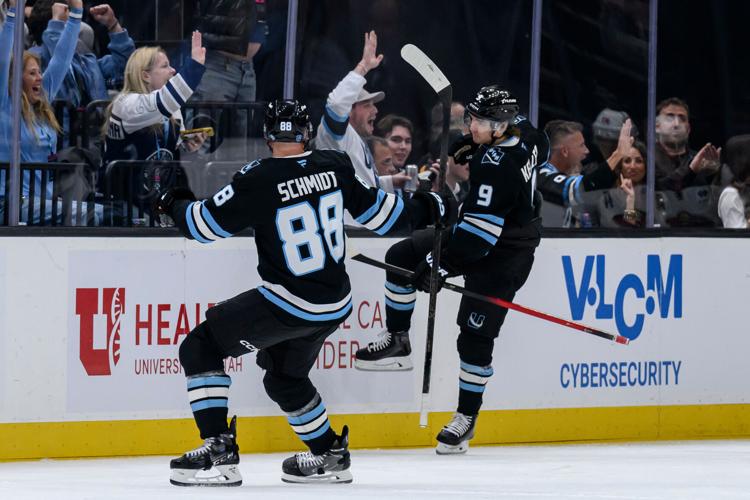
The Mammoth came back from a 1-0 deficit early to score two goals in about 4 minutes by Kailer Yamamoto, giving them a 2-1 lead. After a gifted 5 on 3, the second half of a nearly 4 minute power play saw Carolina tie the game. The Mammoth responded to the goal seconds after, with a rifle of a shot by JJ Peterka, doing what we have wanted him to do for months now. After a second goal by Michael Carcone, just about 7 minutes into the third period, the game looked in hand.
Nothing else happened and everyone was happy forever.
3 GOALS (THE GOOD):
 YAMAMOJO! Yes, they said this on the broadcast, and yes it seems like I’m biting this line. I promise I’m not. I have a list of Kailer Yamamoto puns and fun things to use when he’s good. This was on the list for something special. Well, yesterday his fantastic game was overshadowed by a game no one ever wants to relive.
Yamamoto has played 44 games with the Mammoth and Utah Hockey Club, and in that time he’s had 2 multi-point games. Both have come in the past 4 contests. With 2 goals and an assist last night, Yamamoto has 9 goals, 7 assists through roughly half a season of active play. He’s been really good, filling in for Dylan Guenther and Logan Cooley on the past few nights, as well as when he’s in the lineup on an otherwise slow 4th line.
Yamamoto is on his second one-year contract with Utah. Last year, he was used a dozen times and had 3 points. This year, almost 3 times the use, almost 5 times the points, and a +9 rating. It’s almost as if he should have been playing more this year… Heinz Ketchup-y 57 minutes this team was great. They forechecked, they created a number of odd-man rushes, they saw great playmaking from JJ Peterka and Kailer Yamamoto, they saw great defensive play by Nick Schmaltz and goaltending by Karel Vejmelka.
For 57 minutes, this team showed that it belonged in the conversation about post-season clubs that can make a splash.
For 57 minutes, this team showed it could hang with the big boys. Not only hang, though, but actually punch them in the mouth in their own house.
For 57 minutes, this team completely paid attention to what I suggested in my “keys to victory” and did everything right. Almost there Let me start by saying I hate the world “almost” when it comes to sports. Almost scoring is not scoring. Almost saved it is not saving it. Almost winning is not winning.
This team, though, is almost there. The pieces are there, and they’re visibly growing. Peterka, while in a slump, still has great playmaking ability. Unfortunately, he’s not being utilized in the most ideal way – but his shot is elite and on display yesterday. Sean Durzi and Mikhail Sergachev show flashes of elite puck movement, and a line including John Marino and Nate Schmidt is set for another 2 seasons.
There are a number of up-and-comers too, with Dmitry Simashev and Daniil But on the team at the moment, Maveric Lamoureux pretty much ready and with decent NHL time under his belt from last year and a bit this, and the playoff push this year has been done without Logan Cooley for half the campaign so far.
Things are looking up for the Mammoth, and things are bright. Last night, however…
3 CHIRPS (THE BAD):
 It’s 60 Two nights ago, I wrote that the game is 60 minutes long. I took Utah to task about giving up goals and high quality chances with under a minute left against Florida. I thought, hey, it’s bad giving up chances with under a minute to play.
There’s someone on the team that reads my blog, I am sure of it (hello to you!) because they listened to me. The Mammoth didn’t fall apart with a minute left. Last night, they decided to combine the minute they fall apart in each period and do it all in one lump sum.
I’ll get to the main culprit here momentarily, but Utah played that whole last 10 minutes on their heels. Then once a domino fell, they all did.
The team has those great playoff flashes, but lack the killer instinct that is needed to end games. Florida, Anaheim, and now Carolina are all games that Utah has given up at least a point in. Yesterday was 2 points. If Utah misses the playoffs, this game in particular will be why. No Shot Sherlock Before I had to leave for my PT, I made a comment about how Utah had been doing a great job generating shots against a team that’s been shutting them down. They had 21 shots by the second period, just shy of what Carolina gives up per game (24). The third period, they had 4 shots, one of which was a goal. 4 shot attempts, 3 blocks, and 4 shots on goal. 11 total shot attempts in a third period when Carolina was overcommitting to get offense going.|
Utah had 13 shots on net – not attempts, not blocks, actually on net – in the 2nd period. Utah generated odd-man rushes, had great nose for counter attacks, and were able to make a mountain of a play out of a molehill of a chance.
That third period, they forgot that offense is a great way to counter offense.
There’s a time to turtle in a game. That time is with less than 5 minutes left, doubly so when you’ve got a 6 on 5 or worse. The problem is, not generating shots or counter pressure eventually caused a cascade failure. You can’t play defensively in your end for an entire period – especially after a road trip, especially against 3 straight playoff caliber teams – and expect to come out unscathed. Clear as Day The Mammoth have a problem at center. Yes, Logan Cooley remains out. Yes, Alex Kerfoot is out (and 4th line center is covered anyway). Yes, Nick Schmaltz has been more than capable as a replacement. But the fact remains, there’s a gaping hole where we need it the most, and that hole is being filled by someone that is no longer deserving of a roster spot.
This year’s version of Hayton is a trainwreck, and the Mammoth are paying a heavy price for it.
He’s no longer an offensive threat.
Barrett Hayton scored 20 goals for the Utah Hockey Club last year, en route to a career best 46 point season. After a 2022 campaign that saw a 19 goal, 43 point season, (2023 he was injured most of the year), he seemed to have a solid trajectory into a perennial 40 point player and 20 goal scorer.
He’s got 7 goals this year, two of which were recent empty net goals. His shooting percentage is at a non-injury career low, under 8%. His previous worst? 4.5% in an injury shortened 2023 campaign. His average year? 10.6%. Take those two empty net goals away, and his shooting percentage drops down to 5.6% success at shooting when a goaltender is in net. He’s nearly half as good scoring this year as he was in any average year beforehand.
He’s got 3 goals on the power play, but 4 total points – pacing for 45% of last year’s total. Hayton got his first multi-point game of the year against the Islanders on January 1st. He didn’t hit double digits in total points until January 3rd. He didn’t get his first power play goal until Thanksgiving.
Hayton’s points through 2025’s season were goals and primary assists. He had more primary assists than secondary in his career until this year. That’s flipped, and a sign that he’s further away from impactful playmaker than he has been ever before.
He’s a power play liability.
Hayton spends time on the power play. Note, the Mammoth power play is dead last in the league. 15% power play effectiveness means a goal every 6-7 attempts. The league average is one in 5.
I’ve spoken at length about how poorly the power play has been, and Hayton’s contributions – or lack thereof – is a massive reason for this decline. His tip/deflection rate in front of the net is less than half of where he was last year. He’s either not getting the hand-eye coordination needed to get the puck to the net or, what seems to be to the eye test, simply not getting there.
Without a net-front presence, Hayton’s participation on the power play is destroying the momentum of the unit. With the mentioned 5.6% shooting rate with a goalie in net, when the puck comes to his stick, chances are the play is going to end poorly.
He’s a penalty kill liability.
He doesn’t play penalty kill, though, so how does he affect the PK? He’s not on the penalty kill because he seems to be the reason for it more often than not.
Is he the worst at taking penalties? No, Jack McBain is by numbers, and Liam O’Brien by time on ice. Plus, Hayton is also the one drawing the most penalties for Utah. However, in just 49 games, Hayton nearly career high penalty minutes – with 4 of those earned last night in a sickening display of undisciplined play. In 12 games, he’s had at least one minor penalty (a 10 minute misconduct penalty was assessed in the 13th game, but doesn’t give any power play scenarios to either side). For comparison, in 2024 he had 13 games with a minor penalty in the year.
His penalty minutes a game are up 50% from his career averages. In his career, up until 2025-26, Hayton drew 33 more penalties than he took – a massive boost for a normal team with a normal power play. It allows defensive defensemen rest, and allows the team a chance to score.
This year Hayton’s net negative on drawing vs. taking penalties. Responsible for 2 more penalty kills than power plays, he’s doing the opposite of the above. Tiring out defensive defensemen and forwards, and allowing high danger chances against. Last night, the cascade of problems stemmed specifically from his double minor.
With a defensive core responsible for a 4 minute kill, your best defenders are tired and overworked late in a game. Additional fatigue, late, forces a team to play less capable defenders when trying to hold a lead. When either tired defenders, or less capable ones, fail at their job, it increases stresses across the team. In a normal game, this can be overcome. Against a team capable of a deep Cup run? The breakdown was taken advantage of spectacularly for Carolina – and devastatingly for us.
A shooting liability on the power play, no net-front presence to even account for a lack of point totals, and a net negative on penalties drawn vs. taken are all recipes for disaster.
Is it all bad?
No, no player is bad at everything, and Hayton has a number of things he’s really good at. His faceoff percentage is one of the best on the team, just shy of Kevin Stenlund’s team high 53.5%. Of skaters taking more than 100 faceoffs for the year, Hayton’s just outside the top 50 ranking. So, he’s able to get possession slightly better than the average.
His takeaway rates – how often he’s able to get the puck from the opposition – is 6th best on the team. He’s not known as a guy that hits, but he does have good board presence and can win puck battles. His puck possession numbers are all good – not great – but good enough that he can help sometimes continue a play in the offensive zone, where more skilled players can thrive.
This is noticeable in his +6 rating this year, as helping continue play with takeaways and won battles isn’t noted on a scoresheet, but does still impact team momentum and play.
What to do?
It’s clear that if Utah wants to make a move in the playoffs this year, a change needs to happen. A second line center, a need for some time, is clear. I’ve made the case that moving Jack McBain to the 3rd line wing and slotting Hayton in that position could make sense, but after a deep dive of the numbers and trends, I no longer feel this is the case.
As an RFA, Utah continues to hold all the cards with Hayton’s contract, so even though his contract is expiring this year, the Mammoth hold all the cards to his future. As such, a package deal that includes Hayton can be made for Utah to acquire a center that’s a better fit for Utah’s growing needs.
A great trade target, in my mind, has been Shane Wright of the Seattle Kraken. Wright’s underlying numbers are still good, but they’ve declined and Seattle has limited his usage. With a skilled, fast team, Wright seems like he can have an offensive rejuvination. On a line with Daniil But and JJ Peterka, Shane Wright seems to be an ideal fit. Meanwhile, Seattle could use a player like Hayton who is a little bigger and better at board battles, a much better face-off presence, and someone who can also use a change of scenery.
Swapping Hayton – a 5th overall pick – for Wright – a 4th overall – could be beneficial for both players.
Note: Wright scored twice last night against Toronto, and with increasing time played per game the past few, either Seattle is looking to showcase him, or they’re turning around and wanting to give him another shot. Hopefully Bill Armstrong has an iron in that fire either way.
Worst case scenario for Utah – when Logan Cooley returns, Hayton can be moved down, or healthy scratched. Remember, Cooley – Utah’s best center – was benched for a period for a single mistake. Barrett Hayton shouldn’t skirt accountability just because he’s been with the team longer.
Next up:
Team Tusk comes home after a difficult road series facing division rival and potential playoff matchup partner in the Dallas Stars. 7PM puck drop, game on Utah16, SEG+, or live at the Delta Center.


 Salty Stampede
Leave a comment